Eamon Blog
Today's Shelf Pull: Aretha Franklin, Aretha's Greatest Hits
Familiar titles, fresh reasons to stay for both sides.

Across two sides, the familiar songs become a study in vocal authority, emotional scale and the usefulness of a well-placed change of pace.
A greatest hits title can make a record sound like a job already done: recognise the names, nod approvingly, move along. Aretha Franklin's Aretha's Greatest Hits asks for rather more attention than that. On vinyl, its two sides give the familiar songs room to become performances again, rather than entries in a mental list. Recognition is only the doorway.
For today's shelf pull at Kilmorna in Listowel, the attraction is the distance between those performances. Franklin can make a compact song feel forceful without making every moment equally forceful. Listen for the relationship between the lead voice and the arrangement: the rhythm supplies movement, but her phrasing decides where the emotional weight lands. Those are not always the same place.
Released in 1971, this compilation draws on her Atlantic recordings from 1967 to 1971. There are seven tracks on each side. That is a useful amount of ground to cover: enough variety to reveal an approach, without asking a listener to turn the afternoon into a research project.
The sequence begins with Spanish Harlem, not Respect. It is worth noticing that choice before familiarity takes over. The opening offers an invitation into Franklin's interpretive range, rather than treating the best-known declaration as the only possible front door.
Side A moves from Spanish Harlem into Chain Of Fools and Don't Play That Song. Listen to how a firm rhythmic setting gives the voice something to push against. The pleasure is not simply in power, although there is plenty of that. It is in the sense of a singer shaping the pressure, letting one phrase carry more insistence than the next.
I Say A Little Prayer changes the emotional angle without abandoning that forward motion. Here, lightness and commitment need not be opposites. Franklin's delivery makes room for both, and the surrounding voices help turn a private feeling into something shared. It is a useful place to listen past the tune you remember and attend to how the performance holds itself together.
Dr. Feelgood then asks for a different kind of attention. Rather than waiting only for the voice to rise, follow the space around it. The contrast between restraint and release matters as much as the eventual force. Loudness alone would be a much simpler business.
Let It Be and Do Right Woman - Do Right Man close the first side. Placed here, they encourage a slower reading of what has come before. The record has not merely demonstrated vocal strength; it has shown how many different emotional purposes that strength can serve.
Turning the record changes the scale. Bridge Over Troubled Water opens Side B at 5:31, the longest track listed on the album. Respect follows at 2:26. Before considering either performance in detail, those timings suggest two very different ways of occupying a listener's attention.
Give Bridge Over Troubled Water its full span rather than treating it as the wait before Respect. Its position makes patience part of the sequence. The shorter song that follows then feels especially concentrated, a reminder that duration and emotional size are separate measurements.
Baby I Love You and (You Make Me Feel Like) A Natural Woman follow Respect. This stretch is a good corrective to the idea that a commanding singer must always sound as though she is issuing instructions. Listen for warmth within the authority. The emotional centre shifts towards affection, and the voice remains decisive without making tenderness seem like a lesser register.
I Never Loved A Man (The Way I Love You) complicates that warmth. The title alone announces a personal reckoning, but the listening interest lies in the delivery rather than the statement. Notice how Franklin gives a phrase direction: not just reaching its end, but making the arrival matter. Across these songs, intensity takes several shapes instead of settling into one impressive pose.
You're All I Need To Get By carries the second side towards Call Me. The compilation includes interpretations alongside its signature hits, and this closing stretch keeps the emphasis on what Franklin does with a song. Familiar material is a starting point, not a finished instruction.
Call Me is an apt final title for a record so concerned with address. Again and again, these performances feel directed towards someone rather than projected vaguely outwards. That distinction helps explain why an album full of recognisable names can still reward quite close, ordinary listening.
There is no need to approach Aretha's Greatest Hits as a test of what you already know. Start with the song that catches you, then notice what its neighbours change. A ballad can make the next compact performance seem sharper; a forceful passage can make a gentler one feel more exposed. The sequence does useful work.
That is the reason to spend time with both sides. The collection offers more than a succession of memorable titles: it lets you hear authority expressed as insistence, affection, patience and vulnerability. Franklin holds those qualities together without flattening their differences. A familiar record, then, with plenty left to notice.
On the shelf today:
Aretha Franklin - Aretha's Greatest Hits
LP, 1971
Soul / Funk
EUR 26.95
Available from The Kilmorna Collection, Listowel
Buy or reserve: https://www.thekilmornacollection.com/vinyl/aretha-s-greatest-hits-lp
Buying vinyl records in Ireland: https://www.thekilmornacollection.com/vinyl-records-ireland
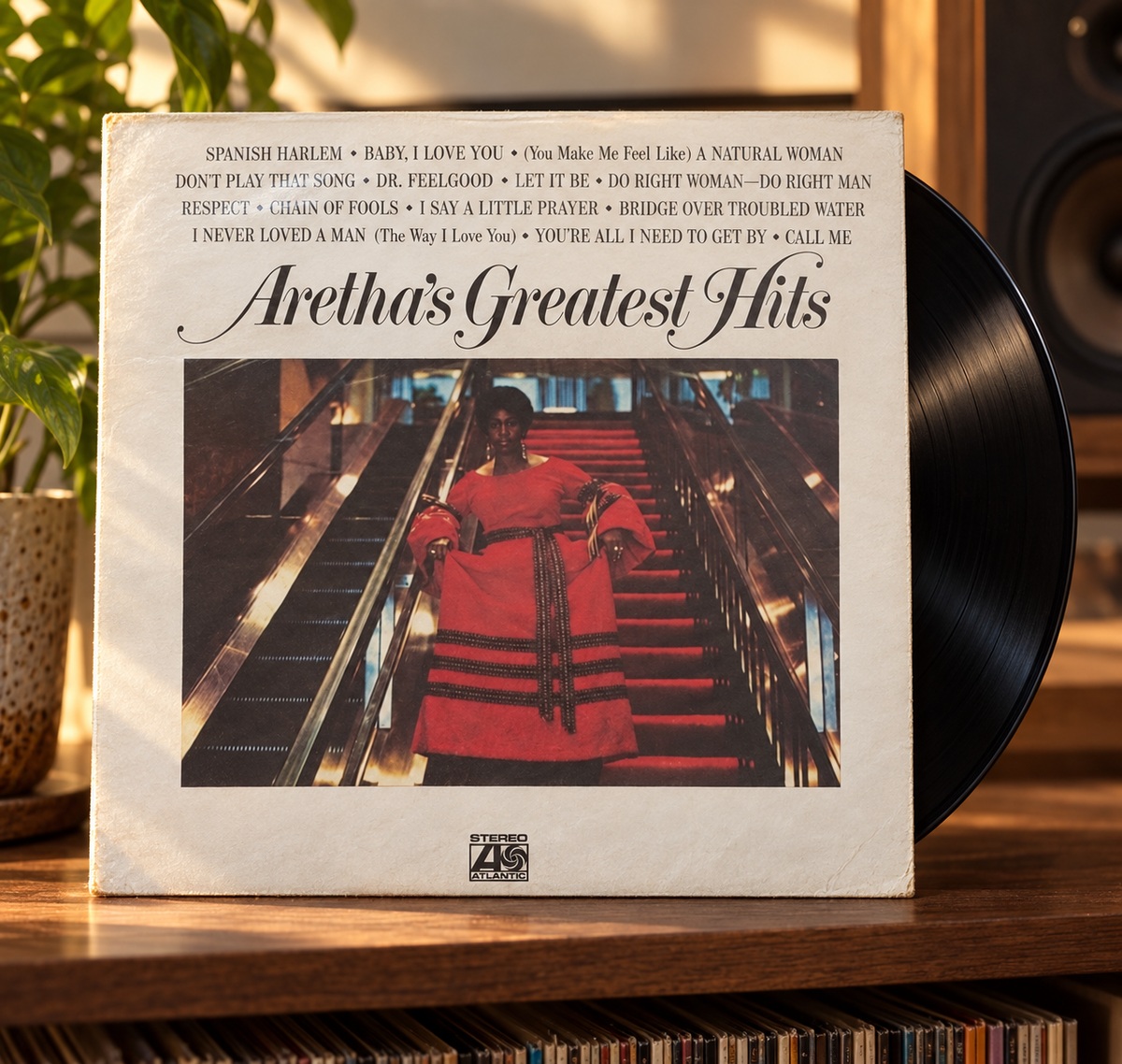
On the shelf today
Aretha Franklin - Aretha's Greatest Hits
LP / Soul / Funk / 1971
EUR26.95 / Available now
Order / Reserve