Vinyl Record
Cream - Disraeli Gears
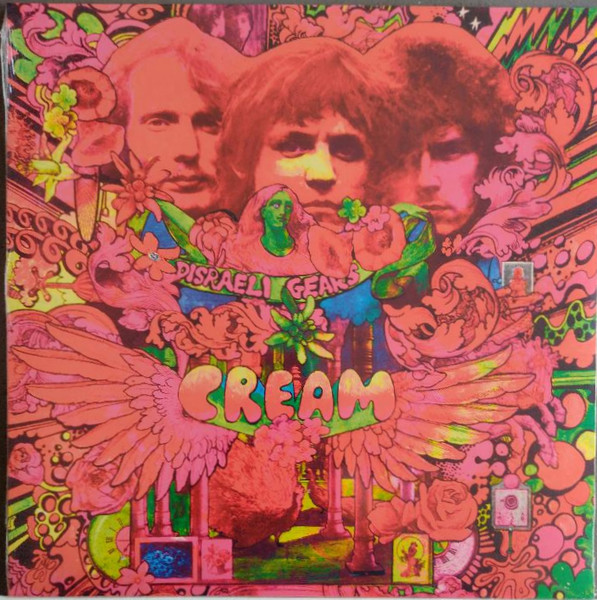
Cream - Disraeli Gears on LP vinyl, released in 1967. Check price, stock, collection and delivery from Kilmorna in Listowel.
LP · 1967
Available from Kilmorna Collection in Listowel.
Buyer notes: 1967 LP, currently available from the Kilmorna Collection vinyl shelf. Pay for pickup in Listowel, ship within Ireland from EUR 5.95 per record or outside Ireland from EUR 12.00 per record.
Disraeli Gears is Cream leaving the blues club and entering the psychedelic century without cutting the cord to either. Released in 1967, the album is the point where Eric Clapton, Jack Bruce and Ginger Baker stop sounding only like a terrifyingly gifted power trio and start sounding like a band with its own pop mythology. Fresh Cream had already proved the force of the players. Disraeli Gears compresses that force into songs that are shorter, brighter, stranger and more memorable. The result is one of the clearest late-1960s examples of blues technique being rerouted through studio colour, surreal language and hard rock density. The album's opening pair tells the story quickly. Strange Brew has blues DNA, but the performance is sleeker and more spectral than straight revivalism. Sunshine of Your Love then supplies one of rock's defining riffs, a line so heavy and economical that it changed the scale of what a trio could imply. Jack Bruce's vocal, Clapton's guitar tone and Baker's drumming create a sound that is not jam-band sprawl, even though the players were famous for improvisational fire. It is concentrated force. World of Pain and Dance the Night Away push the record toward dreamier colours, while Blue Condition gives Baker his own odd corner of the album's personality. Side two deepens the record's strange authority. Tales of Brave Ulysses connects Clapton's guitar language to a more mythic, painted form of psychedelia, helped by Pete Brown's words and the album's appetite for sensory overload. SWLABR turns a title that looks like a private joke into a miniature burst of acid-rock menace. We're Going Wrong slows the pace until Bruce's vocal seems to hover in a room full of dread, while Outside Woman Blues keeps the older blues material within reach. Take It Back and Mother's Lament remind the listener that Cream's seriousness was always unstable, capable of satire, pub-song humour and abrupt tonal shifts. That instability is part of the charm. The album is disciplined, but never polite. Disraeli Gears also matters because it changed the public image of virtuosity. Cream were already associated with instrumental command, yet this album does not depend on long solos to prove anything. Instead, it shows how virtuoso musicians could make compact rock songs feel physically huge. Clapton's guitar is sharp, vocal and experimental; Bruce's bass often behaves like a second lead voice; Baker's rhythms pull from jazz habits without losing rock impact. Producer Felix Pappalardi helped organise those forces so that the album feels vivid rather than merely impressive. The psychedelic sleeve may be the visual shorthand, but the deeper story is musical compression: three players turning advanced technique into riffs, hooks and atmospheres that ordinary listeners could carry away. More than half a century later, Disraeli Gears still feels alive because it marks a hinge point. Before it, British blues rock often defined itself through allegiance to American models. After it, heavier psychedelic rock and hard rock would keep learning from the album's tone, density and confidence. Cream were not the only band making that transition, but few records make the movement so audible. It is blues, pop, hard rock and acid imagery all pulling against one another inside eleven compact tracks. For collectors, that makes Disraeli Gears more than a famous 1967 title. It is a record where the guitar age gets brighter, stranger and heavier at once, and where a trio's collective pressure becomes a new kind of rock architecture. The album's durability also comes from its refusal to choose between personality and form. Bruce, Baker and Clapton each remain recognisable, but the record never feels like three separate showcases stitched together. Even the oddities belong. The nursery-rhyme ending, the painted lyricism, the hard blues undertow and the pop choruses all help define a band that could sound excessive and disciplined in the same breath. That tension is why Disraeli Gears still rewards album listening rather than only riff recognition.
Disraeli Gears matters because it helped define what a late-1960s rock power trio could be. Cream brought blues skill, jazz-informed rhythm and high-volume guitar language into songs that were psychedelic, concise and commercially powerful. Sunshine of Your Love alone would secure the album's place, but the full record shows a wider transformation: blues-rock musicians turning technical command into colour, hooks and new sonic density. The album also marks a crucial bridge between British blues and hard rock. Its riffs, tones and compact intensity point forward to the heavier guitar music that followed, while its surreal language and bright visual identity tie it firmly to 1967 psychedelia. For collectors tracing the development of rock albums as cultural objects, Disraeli Gears is central: not just because the players were famous, but because the record made their virtuosity feel newly shaped, memorable and modern. Its importance is also musical rather than only iconic. The album shows that advanced players did not have to choose between instrumental fire and memorable songwriting. By shortening the forms, sharpening the hooks and letting studio colour alter the blues foundation, Cream helped establish a path that later heavy psych, hard rock and blues-rock bands would keep revisiting. Disraeli Gears is one of the records where that path becomes audible in real time. It remains a compact lesson in how heaviness can be colourful.
For a Cream collection, Disraeli Gears is indispensable. Fresh Cream introduces the trio's blues force, and Wheels of Fire expands their live and studio scale, but this is the album where the band's identity becomes instantly recognisable to listeners outside musician circles. It has the songs, the tones, the cover image and the historical position. Collectors should value it as a complete 1967 statement rather than only as the home of Sunshine of Your Love. Strange Brew, Tales of Brave Ulysses, SWLABR, We're Going Wrong and Outside Woman Blues reveal different parts of the band's chemistry: pop instinct, psychedelic theatre, blues memory and emotional unease. It belongs beside core albums by Jimi Hendrix, The Doors, Jefferson Airplane and early Led Zeppelin for anyone mapping how rock became heavier and more visually charged without abandoning songcraft. It is also a practical classic-rock shelf builder because it works from several angles at once. Guitar collectors get Clapton's tone and phrasing, rhythm-section listeners get Bruce and Baker pushing against the limits of a trio, and psychedelic-era listeners get a record saturated with colour and strange language. Few albums from 1967 combine such immediate recognisability with so much performance detail. That makes Disraeli Gears a repeat-listen title, not just a historically important one. It rewards both casual play and close attention to arrangement.
Psychedelic blues-rock and early hard rock with thick guitar tone, lead-like bass movement, jazz-aware drumming, compact riffs and surreal late-1960s colour.
Recommended for: Collectors building a late-1960s psychedelic rock foundation; Guitar listeners tracing blues-rock into hard rock; Fans of compact albums where virtuosity becomes songcraft.
What year is Disraeli Gears from? Disraeli Gears was released in 1967 as Cream's second studio album. What are the key songs on Disraeli Gears? Sunshine of Your Love, Strange Brew, Tales of Brave Ulysses, SWLABR and We're Going Wrong give the clearest sense of the album's range. Why is the album important? It helped connect British blues-rock, psychedelia and early hard rock, showing how a power trio could sound heavy, colourful and concise at the same time.