Vinyl Record
Creedence Clearwater Revival - Green River
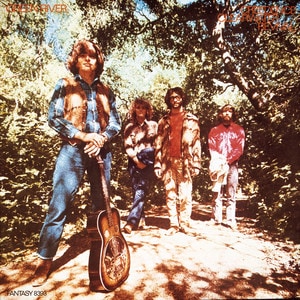
Creedence Clearwater Revival - Green River on LP vinyl. A 1969 record available from Kilmorna Collection in Listowel, Ireland.
LP · 1969
Available from Kilmorna Collection in Listowel.
Buyer notes: 1969 LP, currently available from the Kilmorna Collection vinyl shelf. Pay for pickup in Listowel, ship within Ireland from EUR 5.95 per record or outside Ireland from EUR 12.00 per record.
Green River is Creedence Clearwater Revival at the moment their sound becomes unmistakable. Released in 1969, it was the band's third studio album and part of an astonishing year in which they issued three full-length records while dominating singles charts with a frequency that now seems almost unreal. Bayou Country had already given them Proud Mary and Born on the Bayou, proving that John Fogerty's imagined South could become a commercial and musical force. Green River tightens that discovery. It is shorter, sharper and more focused, a record where the swamp-rock identity no longer feels like an arrival but like a fully working machine. The title track sets the tone with one of Fogerty's most evocative pieces of memory writing. Green River sounds nostalgic, but not soft. Its guitar figure and clipped rhythm make childhood recollection feel physical: rope swings, riverbanks, heat, smell and motion turning into rock and roll. Commotion follows with the other side of the band's gift, a rush of modern pressure and locomotive energy. Tombstone Shadow brings blues superstition into a lean rock form, while Wrote a Song for Everyone slows the record down without losing tension. Bad Moon Rising is the album's most famous collision of brightness and dread. Its melody seems almost cheerful until the lyric opens the sky and lets disaster in. The second half proves how much range CCR could fit into plain forms. Lodi turns failure on the road into a singable working musician's lament. Cross-Tie Walker and Sinister Purpose sharpen the band's darker edge, while The Night Time Is the Right Time links them back to R&B history without turning the album into a museum exercise. The performances are direct, but direct does not mean simple-minded. Doug Clifford's drumming and Stu Cook's bass give the songs their durable frame; Tom Fogerty's rhythm guitar keeps the band compact; John Fogerty's voice and guitar carry urgency, humour, suspicion and longing in quick succession. Green River's greatness lies in how little it needs to prove itself. The album also occupies a crucial place in the larger 1969 rock landscape. This was a year of expanded studio ambition, festival myth, political unrest and changing ideas about what rock albums could contain. Creedence did not respond by becoming ornate. They became more economical. Green River sounds as if it has no patience for excess, but it still carries the era's anxiety in compressed form. Bad Moon Rising hears disaster coming; Lodi hears disappointment; Wrote a Song for Everyone hears a private voice failing to reach the people it wants to reach. Even the sunny parts feel shadowed. That combination of speed, clarity and unease is the record's lasting charge. For collectors, Green River is often the Creedence studio album that best explains the band's magic in one sitting. It has the hits, but it also has the album shape: a fast, taut sequence that moves between memory, warning, travel, failure and night-time release. It captures CCR before the even broader sweep of Willy and the Poor Boys and Cosmo's Factory, when the band's sound had fully bloomed but not yet become overfamiliar through constant repetition. Listening now, the record still feels fresh because the writing is so unsentimental. Green River does not ask to be admired for complexity. It asks whether a two-and-a-half-minute song can carry a whole weather system of American feeling. Again and again, the answer is yes. The record's brevity is part of its authority. Nothing lingers after the song has made its point, and yet the album never feels slight. That is difficult to do. Creedence use repetition, tone and rhythm with the discipline of a working band that knows exactly where the energy lives. The result is an album that can sound casual on first play and almost severe on the tenth. Every riff has a job, every chorus opens quickly, and every shadow deepens the bright surface around it.
Green River matters because it is one of the clearest full-album statements of Creedence Clearwater Revival's sound. In 1969, the band were working at extraordinary speed, and this record shows that productivity did not weaken their focus. Bad Moon Rising, Green River and Lodi became lasting songs because they pair immediate hooks with images of dread, memory and disappointment that keep deepening over time. The album also marks the moment when CCR's classic identity feels completely formed. The Southern imagery, California reality, clipped arrangements, roots vocabulary and Fogerty's urgent voice all lock into place. In an era when many rock groups were expanding outward, Creedence made compression feel powerful. For collectors of 1960s rock, Green River is essential because it shows how much atmosphere and social weather a lean band could generate without elaborate studio architecture. It also matters because the album makes economy feel expressive. The songs are short, but they do not feel underwritten; they feel exact. Fogerty's images are simple enough to be remembered and strange enough to last, while the band keeps each performance close to the bone. Green River is a reminder that album importance does not always come from scale. Sometimes it comes from a band finding its voice and wasting almost nothing. That discipline gives the record its lasting authority and emotional bite.
For a Creedence shelf, Green River is close to mandatory. It is compact enough to play often and strong enough to stand as a first serious studio-album choice. Chronicle gives the hits, but Green River reveals how those hits belong to a darker, more coherent album world. The non-singles are not filler; they sharpen the record's mood and make the famous tracks feel more rooted. Collectors who care about album flow will appreciate how quickly it moves and how little it wastes. It pairs naturally with Bayou Country for the formation of the sound, with Willy and the Poor Boys for political and communal reach, and with Cosmo's Factory for blockbuster scale. Green River is the tighter blade: nine songs, no sprawl, and a band sounding as if every rhythm and image had been cut to size. It is also a useful record for explaining CCR to someone who only knows the radio staples. The hits are present, but the full album shows how they emerged from a consistent world of river memory, road weariness, superstition and weather. That coherence gives Green River more replay value than a short track list might suggest. It is the kind of album that earns its place by sounding effortless, then revealing how carefully that effortlessness was built. It belongs in any serious roots-rock run.
Taut swamp rock and roots-rock with clipped guitars, driving drums, vivid vocal grit, blues and R&B traces, and bright melodies shadowed by unease.
Recommended for: Collectors choosing one essential CCR studio album; Fans of lean 1969 roots-rock with no wasted motion; Listeners drawn to songs where nostalgia and dread meet.
When was Green River released? Green River was released in 1969 as Creedence Clearwater Revival's third studio album. What are the key songs on Green River? Green River, Bad Moon Rising and Lodi are the best-known songs, with Wrote a Song for Everyone and Tombstone Shadow adding important album depth. Why is Green River so highly regarded? It captures CCR's classic sound in a tight, focused form, balancing hit songwriting with a darker roots-rock atmosphere.