Vinyl Record
Creedence Clearwater Revival - Cosmo's Factory
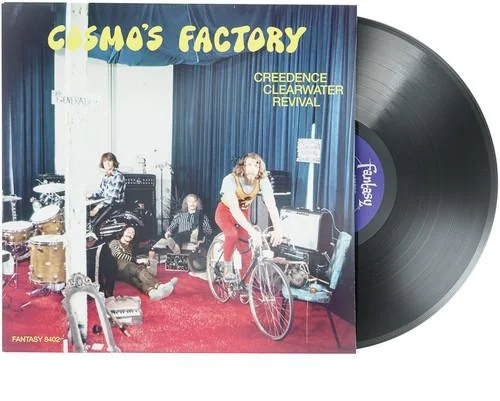
Creedence Clearwater Revival - Cosmo's Factory on LP vinyl. A 1970 record available from Kilmorna Collection in Listowel, Ireland.
LP · 1970
Available from Kilmorna Collection in Listowel.
Buyer notes: 1970 LP, currently available from the Kilmorna Collection vinyl shelf. Pay for pickup in Listowel, ship within Ireland from EUR 5.95 per record or outside Ireland from EUR 12.00 per record.
Cosmo's Factory is Creedence Clearwater Revival at full industrial heat. Released in 1970, it followed an almost absurdly productive run: Bayou Country, Green River and Willy and the Poor Boys had all appeared in 1969, with hit singles arriving so quickly that the band seemed less like a rock act than a generator of permanent radio memory. Cosmo's Factory did not slow the machine down. It widened it. The album takes the lean Creedence formula - clipped rhythms, Fogerty's sandpaper voice, roots vocabulary, direct arrangements - and stretches it into the band's biggest, broadest studio statement. Ramble Tamble opens the album by refusing the idea that CCR were only a singles band. It begins with rockabilly snap, moves into a long, churning instrumental middle and returns with renewed force, as if the band wanted to prove that economy and expansion could coexist. Before You Accuse Me reaches back to blues repertoire, while Travelin' Band hits like a Little Richard engine rebuilt for 1970 radio. Ooby Dooby connects the group to early rock and roll, and Lookin' Out My Back Door turns country bounce, surreal imagery and pure pop pleasure into one of Fogerty's most disarming songs. By the end of side one, the album has already moved through several versions of American music without sounding scattered. The second half is even stronger. Run Through the Jungle gives the record its dark, humid centre, often heard as one of CCR's most ominous performances. Up Around the Bend answers with forward motion and open-road lift. My Baby Left Me keeps the band tied to rock and roll's earlier language, while Who'll Stop the Rain distils disillusion into a song so simple it feels carved rather than written. I Heard It Through the Grapevine becomes a long Creedence groove, proof that the band could transform Motown-associated material without treating it as novelty. Long as I Can See the Light closes the album in a glow of homesick gospel-soul, with Fogerty's vocal carrying exhaustion, hope and distance at once. Cosmo's Factory matters because it contains nearly every Creedence strength in expanded form. The band could be blunt, but they were not narrow. They could cover older songs without becoming revivalists. They could write protest-adjacent material without losing melody. They could make radio singles that sounded handmade rather than polished into anonymity. The album's title, linked to drummer Doug Clifford's nickname and the band's practice space, fits the record's feeling of work. This is not psychedelic drift or studio indulgence. It is craft under pressure, the sound of a band rehearsed to the point where instinct and discipline blur. The album also captures a complicated American moment. In 1970, Creedence were making music that felt old and current at once. Travel, rain, war-shadowed dread, road fatigue, borrowed rock and roll, blues memory, country humour and soul longing all move through the record. Fogerty's writing often works because it avoids over-explanation. Who'll Stop the Rain does not need to name every disappointment it carries. Run Through the Jungle does not need to pin down a single fear. Long as I Can See the Light does not need to decide whether it is about homecoming or exile. For collectors, Cosmo's Factory is the blockbuster Creedence album that still feels hand-built: packed with famous tracks, deep cuts that justify the full sequence, and performances that show a short-lived band operating at frightening confidence. Its greatness is also in the way it absorbs outside material into the band's own voice. The covers do not interrupt the album; they clarify the world Creedence came from and the lineage they wanted to claim. At the same time, the originals are so strong that the borrowed songs never dominate. That balance gives Cosmo's Factory unusual fullness. It feels like a jukebox, a road record, a protest-era reflection and a band-room workout all at once, held together by an unmistakable rhythm and vocal signature.
Cosmo's Factory matters because it is Creedence Clearwater Revival's most expansive studio triumph. The album gathers hit-level songwriting, deep roots knowledge and band discipline into a sequence that feels both wide-ranging and unmistakably unified. Travelin' Band, Lookin' Out My Back Door, Run Through the Jungle, Up Around the Bend, Who'll Stop the Rain and Long as I Can See the Light would be a remarkable run for a compilation; here they live inside one album. It also shows CCR's unusual relationship to American music history. The band draw from rockabilly, blues, country, R&B and soul without sounding academic or nostalgic. Everything is pushed through their own tight arrangement style and Fogerty's urgent voice. For collectors, the album is central because it captures the group's peak confidence: commercially huge, musically direct and still rough enough to feel alive. The record's importance is amplified by its timing. It arrived after a year in which Creedence had already produced more essential material than many bands create in a career, yet it does not sound exhausted. Instead, Cosmo's Factory sounds like momentum becoming mastery. That makes it one of the clearest examples of a band converting relentless work into a major artistic statement. Its range also makes it the best single album argument for CCR as more than a singles machine.
For a Creedence shelf, Cosmo's Factory is the major statement. Green River may be tighter, and Chronicle may be the cleanest summary of the hits, but Cosmo's Factory gives the fullest picture of the band at scale. It has the famous songs, the covers, the long groove, the dark centre and the weary closer. That range makes it the CCR album most likely to satisfy both casual listeners and album-first collectors. It is also a strong choice for anyone building a classic rock collection around records that behave like greatest-hits albums without actually being compilations. The sequence is loaded, yet it never feels like a bundle of unrelated successes. The band sound locked in, economical when needed and expansive when the song demands it. Its collector value is musical: depth, impact, consistency and a near-perfect snapshot of Creedence at their peak. It also pairs beautifully with Chronicle because the two records answer different needs. Chronicle gives the concentrated public memory; Cosmo's Factory gives the album-scale experience of a band at full command. For collectors who already know the hits, this is where the deeper satisfaction often begins. The familiar songs are present, but the surrounding performances make the album feel like a complete working environment rather than a set of isolated peaks. It is a cornerstone, not a side purchase.
Peak-era swamp rock and roots-rock with rockabilly drive, blues covers, country bounce, ominous grooves, soul-tinged balladry and Fogerty's urgent vocal rasp.
Recommended for: Collectors looking for the fullest CCR studio-album statement; Classic rock listeners who want hits and deep cuts together; Fans of roots-rock albums with range, drive and no polish overload.
What year is Cosmo's Factory from? Cosmo's Factory was released in 1970 as Creedence Clearwater Revival's fifth studio album. What are the key songs on Cosmo's Factory? Travelin' Band, Lookin' Out My Back Door, Run Through the Jungle, Up Around the Bend, Who'll Stop the Rain and Long as I Can See the Light are central tracks. Why is Cosmo's Factory often considered a peak CCR album? It combines major songs, strong covers, tight band performance and a broad roots-rock range while still sounding direct and cohesive.