Vinyl Record
David Crosby - If I Could Only Remember My Name
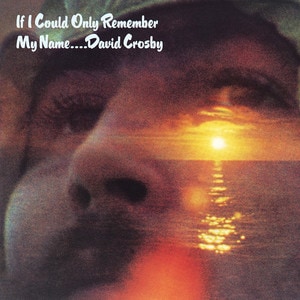
David Crosby - If I Could Only Remember My Name on LP vinyl. A 1971 record available from Kilmorna Collection in Listowel, Ireland.
LP · 1971
Available from Kilmorna Collection in Listowel.
Buyer notes: 1971 LP, currently available from the Kilmorna Collection vinyl shelf. Pay for pickup in Listowel, ship within Ireland from EUR 5.95 per record or outside Ireland from EUR 12.00 per record.
If I Could Only Remember My Name is the David Crosby solo album that feels least like a conventional solo debut and most like a room full of West Coast musicians catching one another in a fragile, volatile hour. Released in 1971 after the explosion of Crosby, Stills, Nash & Young, it arrives from a moment when each member of that circle was trying to define a private language outside the group. Crosby's answer was not a singer-songwriter record in the tidy sense. It is loose, communal, grief-shadowed, exploratory and unusually atmospheric, built around voices, guitars and open-ended arrangements that seem to drift before they reveal their shape. The album has long carried a reputation as a cult favorite because its power is not only in individual songs but in the whole emotional temperature it creates. Music Is Love opens with a communal glow, but the record soon moves into stranger terrain: Cowboy Movie stretches into a cinematic band performance, Tamalpais High turns landscape into feeling, Laughing suspends time around Garcia's steel-like guitar presence, and I'd Swear There Was Somebody Here closes with wordless mourning rather than resolution. The guest list matters, but the album is not valuable simply because famous friends appear. What makes it endure is how those players serve Crosby's interior weather. Members of the Grateful Dead, Jefferson Airplane and Santana, alongside Graham Nash, Neil Young and Joni Mitchell, help create a sound that belongs to a particular post-1960s California: beautiful but uneasy, open but wounded, confident in musical freedom yet unsure what freedom is supposed to heal. Crosby's voice often sounds less like a narrator than a signal passing through the ensemble. The harmonies are luminous, but they are rarely decorative. They blur the boundary between companionship and haunting, as though friendship itself has become part of the arrangement. The album also rewards listeners who come to it after the better-known CSN and CSNY landmarks. In the group, Crosby often supplied mystery, political urgency and harmonic depth; here those qualities take over the whole frame. The songs do not rush to become hits. They breathe, repeat, dissolve and reassemble around texture. That makes the record feel modern in a way that many cleaner period pieces do not. Its folk-rock roots are obvious, yet its sense of space points toward ambient Americana, psychedelic soul-searching and the later taste for albums that work as environments. It is a record about memory, loss and fellowship, but it does not explain itself in plain language. It asks the listener to live inside its haze and notice how much detail is moving there. For Crosby, it became a defining statement because it captured something that could not be recreated by simply assembling the same names again. It is the sound of a community trying to carry one of its own, and of one artist turning confusion into a singular musical atmosphere. Another reason the album keeps deepening is its refusal to make the listener choose between songcraft and atmosphere. Crosby had already proved he could write memorable pieces inside a group, yet here he trusts fragments, chants, modal vamps and collective intuition to carry meaning. That trust gives the album an almost documentary quality. It catches musicians listening for one another, not simply executing finished arrangements. The record also sits at the emotional aftermath of a major personal loss for Crosby, which gives its floating quality a human gravity. Nothing here feels like escapism for its own sake. The beauty is often unstable, and the instability is what prevents the album from turning pretty in a shallow way. It is also a rare classic-rock-era album where silence and space feel as important as virtuoso display. The performances are skilled, but the deepest skill is restraint: knowing when to let a harmony hover, when to let a guitar answer instead of dominate, and when to leave the ache unresolved.
The album matters because it reframes David Crosby as more than one voice in a famous harmony group. It shows the part of his art that was spacious, risky and emotionally unsettled, and it turns that part into a full-length world. In 1971, listeners could have expected a more direct extension of CSN or CSNY. Instead, Crosby made a record that behaves like a collective dream: songs stretch, voices overlap, guitars converse, and grief becomes part of the sonic architecture. That approach helped the album outgrow its initial mixed reception. Later generations found in it a model for loose collaboration, atmospheric folk-rock and the idea that an album can hold uncertainty rather than solve it. It also preserves a rare meeting point between several West Coast scenes without becoming a souvenir of celebrity friendship. The players are impressive, but the deeper importance is how fully the ensemble bends toward Crosby's mood. For anyone tracing the afterlife of the 1960s into the early 1970s, this is one of the records where hope, exhaustion and musical openness can all be heard at once. It also matters because it has become one of the key records for understanding the porous boundary between folk-rock, psychedelic improvisation and the Bay Area jam community. Rather than presenting those worlds as separate scenes, the album lets them converse inside Crosby's own songs. That makes it a lasting touchstone for listeners interested in musical community as a creative method.
For collectors, If I Could Only Remember My Name is worth treating as a central David Crosby title rather than a side trip from the larger CSN story. It connects directly to the Crosby, Stills, Nash & Young era, but it has its own atmosphere and its own reason to be on the shelf. The album is especially rewarding in a focused listening session because its quieter details carry much of the charge: the layered voices, the patient guitar lines, the sudden shifts from communal warmth to private desolation. It also pairs naturally with the early solo work by Stephen Stills, Graham Nash and Neil Young, where the members of that world each tested a different version of independence. This is the most spectral and communal of those statements. Buyers should think of it as an album experience, not a hits collection. Its value comes from mood, continuity and musicianship rather than a sequence of obvious singles, and that is exactly why it keeps gaining listeners long after its original moment. In practical collection terms, it is also a record that changes character depending on what surrounds it. Next to CSN titles, it highlights Crosby's stranger instincts; next to Grateful Dead-adjacent material, it reveals a more intimate and vocally centered side of that musical neighborhood. That flexibility gives it long-term shelf life beyond completism.
Open, hazy and communal folk-rock with luminous stacked harmonies, exploratory guitar passages, soft psychedelic drift and a deep undertow of grief.
Recommended for: CSN and CSNY listeners who want Crosby's most distinctive solo statement; Collectors drawn to Laurel Canyon, West Coast folk-rock and communal studio chemistry; Late-night listeners who like albums that unfold as atmosphere rather than argument.
What year is If I Could Only Remember My Name from? It was released in 1971 and is David Crosby's debut solo album. Is it basically a Crosby, Stills, Nash & Young album? No. Members of that wider circle appear, but the album is led by Crosby's own mood, writing and sense of open-ended arrangement. What kind of listener will enjoy it most? It works best for listeners who enjoy atmospheric folk-rock, patient ensemble playing and records that reveal their emotional shape over repeated plays.