Vinyl Record
Lester Young - Blue Lester
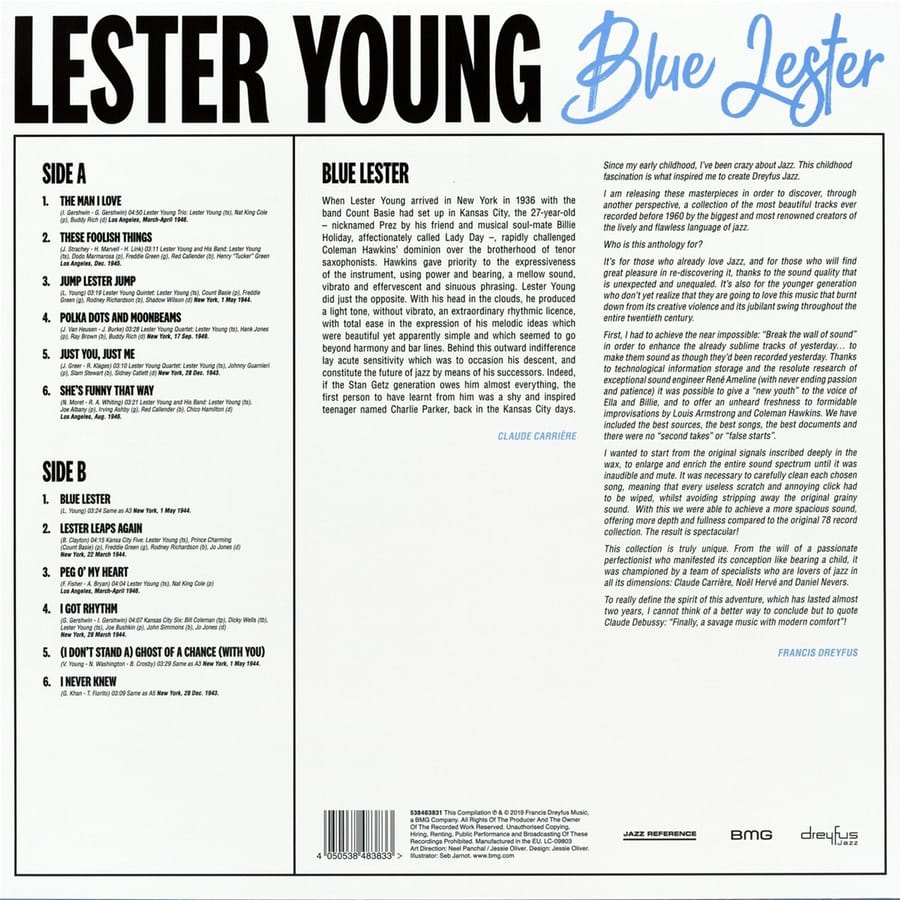
Lester Young - Blue Lester on LP vinyl. A 1956 Jazz record available from Kilmorna Collection in Listowel, Ireland.
LP · Jazz · 1956
Available from Kilmorna Collection in Listowel.
Buyer notes: 1956 LP, currently available from the Kilmorna Collection Jazz shelf. Pay for pickup in Listowel, ship within Ireland from EUR 5.95 per record or outside Ireland from EUR 12.00 per record.
Blue Lester draws from Lester Young's mid-1940s Savoy small-group recordings, material that catches him after the first Basie-era revolution but before the late Verve mythology fully settles around him. Issued as a Savoy LP in the 1950s, it places Young in compact settings where his tenor saxophone can move with conversational ease rather than big-band force. The players around him include figures linked to swing, early modern jazz and Kansas City continuity, so the music feels like a bridge between eras rather than a museum object. The appeal is the way Young bends time. On pieces such as I Don't Stand a Ghost of a Chance, These Foolish Things, Exercise in Swing, Blue's N' Bells, June Bug, Blue Lester and Jump Lester Jump, he does not dominate through volume. He floats, delays, clips phrases short, leans into blue notes and lets the rhythm section carry a relaxed pulse beneath him. That lightness is deceptive: it changed the language of tenor playing, offering an alternative to heavier, more declarative saxophone styles. For a jazz shelf, Blue Lester is a concise portrait of a musician whose influence reached bebop, cool jazz and every tenor player who learned that softness could still cut deeply.
Blue Lester matters because it focuses on Young's small-combo voice at a crucial historical hinge. The recordings preserve the elegance and rhythmic freedom that made him one of the decisive tenor saxophonists of the 20th century, while the 1950s LP frame turned earlier 78-era material into an album-shaped listening experience for the modern jazz collector.
This is the kind of Lester Young title that rewards listeners who want more than a broad anthology. It gives the shelf a Savoy-centred view of his postwar language: relaxed blues forms, ballad poise, compact improvisation and the clear trace of a player whose phrasing helped open the door to a cooler, more linear modern jazz sound.
Small-group swing and early modern jazz with airy tenor phrasing, light rhythmic lift, blues touches, unforced ballad tone and a relaxed postwar studio feel.
Recommended for: Jazz collectors tracing the evolution of tenor saxophone language; Listeners who prefer small-combo swing to big-band spectacle; Fans of Billie Holiday-era sensitivity, cool jazz roots and Savoy sessions.
What period of Lester Young does Blue Lester represent? It gathers postwar small-group Savoy material, mainly from the 1940s, later shaped into an LP-era listening sequence. Is Blue Lester a good first Lester Young record? Yes, especially for listeners who want to hear his relaxed tenor phrasing in compact jazz settings rather than only in big-band recordings. Which tracks define the album's character? Blue Lester, Jump Lester Jump, These Foolish Things and I Don't Stand a Ghost of a Chance show its mix of blues ease, swing motion and ballad poise.